


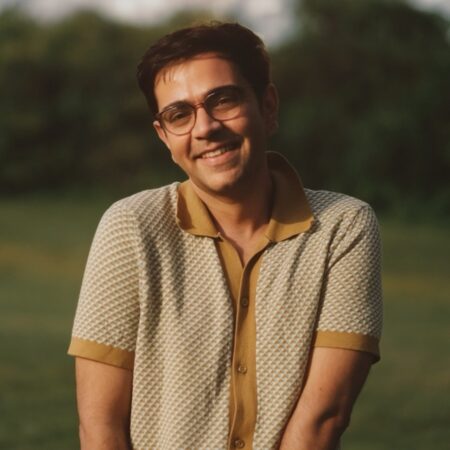
Meet Shastri Akella, winner of the 2025 Desperate Literature Prize for Short Fiction for his short story, Border Ghosts.
How did you decide that writing was what you wanted to do, before the prize? What did that look like for you?
My undergraduate is actually in comp-sci, and I was working for Google for quite some time. So writing was not even my original path. But I was traveling, and I had this very striking image come into my head. It was in part because of my circumstances, where my family wanted me to have an arranged marriage and I hadn’t come out yet, so there was some survival instinct in me that just said no, don’t do this. So in a way I was running away from family, traveling in the Himalayas in India. When I was there I had this very striking image of a young man, alone in his house, transferring pictures from one wall to another. Then there’s only his picture left on the other wall, and he puts on his backpack and leaves the house. That photo wall was a very striking image that is not a part of my reality at all. So I started a journal from his point of view and that eventually became my debut novel, The Sea Elephants.
What books really made you feel connected to fiction?
The first book I read that really influenced me as a writer was The God of Small Things by Arundhati Roy. I was blown away by her ability to write from a child’s point of view. I’ve attempted it in some of my stories, including one that just came out with Wasafiri.
I also loved The Amazing Adventures of Cavalier and Clay, Michael Chabon’s novel, because I love the way he uses comic books as a framing device to tell this very complex story of a boy who’s escaped the holocaust and his cousin, as two migrant children, making their life in New York and creating comic books together.
How did you decide to submit for the Desperate Literature Prize?
My debut novel, The Sea Elephants, was also my MFA thesis, and it was almost 800 pages long. After the novel got published in 2023 (with a humbler length of 370 pages), I wanted to challenge myself to write in the shorter form, so I started working on short stories. When I first saw the Desperate Literature Prize, not the year I entered but the year before, it felt like a real challenge for me to convey an entire experience in two thousand words. So I bought three PDF editions of past prize winners and read them, making notes. It became a learning experience that I knew I would cherish irrespective of whether I won this contest or not.
My second novel works with fantasy, so I wanted to write something that had ghosts in it. The tension on the India Kashmir border was really flaring up at that point, and I had a very close friend who’s a journalist in Kashmir. With all of that was playing in my mind, I imagined ghosts needing human permission to cross a border, which is just a ridiculous rule. I wrote a very rough draft of that story that was still very long, about 4,000 words. Then it was about finding the heart of the story and editing out everything else.
Did you have anyone help you shorten that story? Or did you edit it all on your own?
There’s an editor I deeply admire, Francesca Bellei, who is fiction editor at The Massachusetts Review. She picked up a short story of mine, which was very long, 6,000 words, and helped me find its shape and core. So I reached out to her, seeing if I would be able to work with her one-on-one. She said “There are places where you can trust that the reader is getting what you’re trying to say. It almost seems like you’re trying to give them more and you’re worried they might not get your point.” That feedback helped me with the rhythm of writing and knowing when to pace a story up and when to pace it down, which I think in a short story especially is very important. That and trusting readers that they can make that leap of imagination between all the gaps you’re leaving in the story.
What sort of writing routine helped you move this short story along, if any?
Once I find the pulse of the story and it’s gotten into a flow state, I find that being able to write every day at the same time allows me to fall into that rhythm. If I break that, it becomes hard to re-enter the story. I think a lot of times when I’ve had “writer’s block,” it was more of separating myself too much from the story and having to find my way back in. I try to not give myself a break of more than one day if I’m working on a project, whether it’s a short story or a novel.
I wrote The Border Ghosts this past spring when it was very cold, and I became a complete night owl. From 12:00 AM to 3:00 AM I would read, and from 3:00 AM to 5:00 AM I would write. I was reading the short stories of Ursula Le Guin, Mariana Enriquez, and Ottessa Moshfegh. Enriquez’s short stories are incredible in the way they give you glimpses and leave a lot of gaps that cause productive tension.
Did you set out to write a story that had supernatural elements, or was it something that popped up along the way?
I wanted ghosts in this story, because my second novel has vampires in it, and I am very fascinated by horror. We are programmed to fear ghosts – I’ve always questioned why that is the case. For this story, the main character learns that “you can’t let these ghosts in because they’re evil” but he doesn’t trust that knowledge that’s passed on. And the more he talks to this woman, the ghost, the more he realizes she’s not the problem. I wanted to bring in ghosts and question who we call a monster and who does that calling.
What has it been like for you to win the Desperate Literature Prize?
It was really surprising, and as a writer, it was validating that I can attempt this form. To have two of my literary heroes, Ottessa and Mariana, read it and like it was a huge boost. I’m working on a fantasy novel and I’ve never attempted the genre, so this gave me a lot of confidence. It was like the universe telling me “Yes! Keep going!”
It also gives me hope for my short story collection, that’s on the market in the UK and India as we speak. It’s called A Queer Shade of Saffron. Saffron in India has been co-opted by the right-wing Hindu movement, whereas a lot of Hindu mythology is very queer coded. It is a risk given the current regime; my friends in India said, “Once it’s out, don’t come back to India for about a year because people are crazy right now.” But that risk-taking in the service of a shared truth is vital to our vocation as writers.
What do you love most about what you do, in regards to writing?
With any kind of story I write, irrespective of the form, it’s the same as what I like about reading, which is that it always expands my empathy. I’m able to empathize with realities that I would previously maybe understand and sympathize with, but I think that is just not enough. . This process also allows me to be a more empathetic presence in the lives of my students and friends when I go out into the world.
Is there anything else you want to share?
I’m working on a fantasy novel, which I promised I would give to my agent early next year, so there’s a ticking clock. It’s set in a future where vampires migrate from Ireland and are given asylum in the U.S. because their blood can cure agricultural lands that have gone sterile. So it follows the story of two vampires who have migrated. That’s my next book!
Visit Shastri’s website, www.shastriakella.com
Follow Shastri on Instagram @shastriav
Learn more about the Desperate Literature Prize for Short Fiction